Description
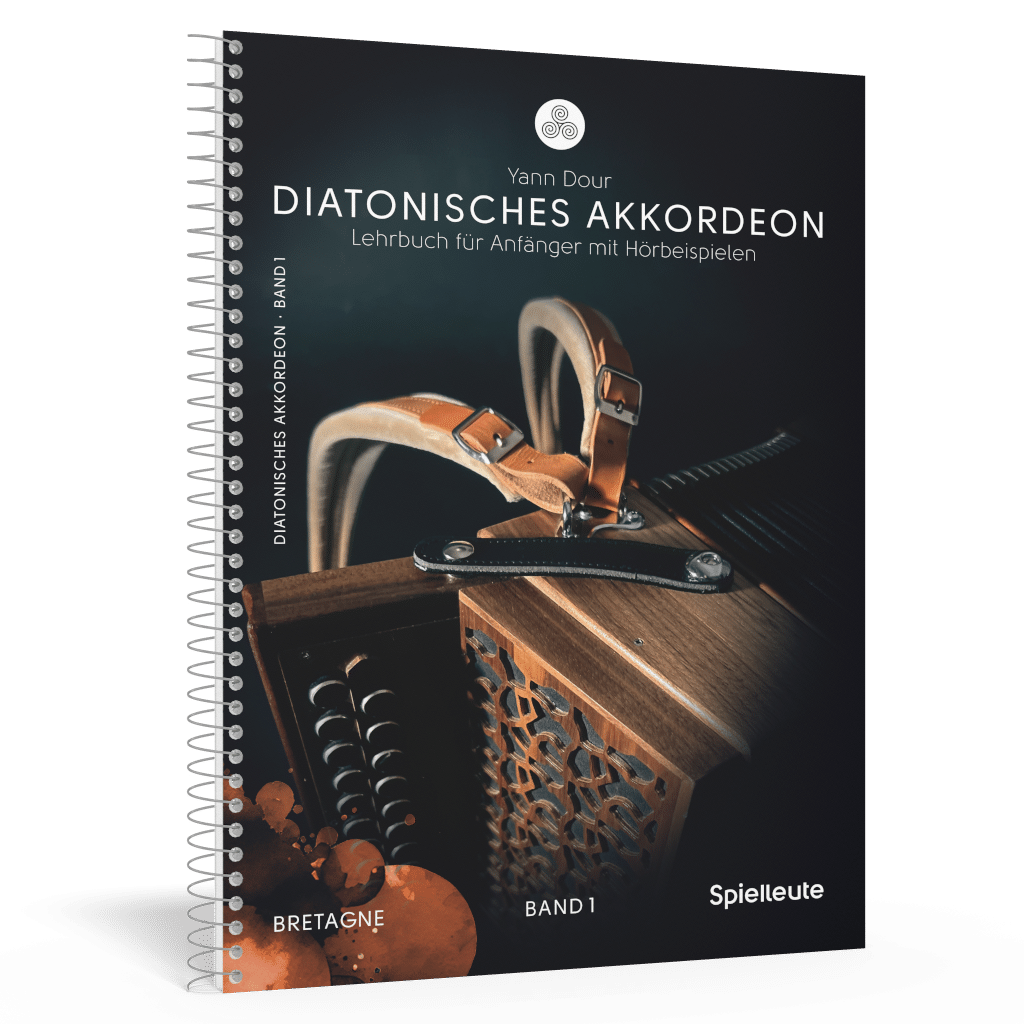
This book is for you if you want to pick up a diatonic accordion and get started – without having to struggle through theoretical ballast. With “Diatonic Accordion – Volume 1”, French musician and teacher Yann Dour has written a practical textbook that has stood the test of time for decades. It teaches you the basics in a playful way and always has one thing in mind: the joy of music.
Learning with ear and heart
Yann Dour’s approach is clear: music should sound good. Instead of mere technical exercises, you will find over 40 traditional pieces in this book that will help you develop your playing technique along the way. These include dances such as the polka, Hanter Dro, waltz, En Dro and mazurka – many of them from Brittany, but also from other European regions.
What makes learning particularly enjoyable is that the exercises and pieces are provided with QR codes. Scan them with your smartphone or tablet and you can immediately listen to how it should sound. This helps you practise, motivates you – and gets you to your goal faster.
Content that really gets you ahead
The first part of the book teaches you in an easy-to-understand way:
-
how the accordion works
-
What you should pay attention to when keeping
-
how you work with your left and right hand
-
how rhythm and note lengths are related
-
and what makes a personal style
You will also get lots of tips on choosing your instrument – from the question of how many rows it should have, to the key and the right tuning.
Clear tablatures – ideal even without knowledge of sheet music
Particularly practical: Yann Dour uses tablature notation so that you can get started straight away without having to read music. What to do is clearly indicated for each key and each bellows movement. This is particularly helpful if you are a self-taught learner or have no previous experience with sheet music.
Music that’s fun – from the very first note
The book is structured in such a way that you get straight into playing – with small success stories on every page. You start with simple exercises and pieces, then improve bit by bit. Little by little you will develop a feeling for rhythm, accompaniment and melody.
The pieces are carefully selected and range from simple children’s songs to dance-like folk music. You will notice how your hands become more confident, how the interplay of bass and melody works – and how much fun it is to make music yourself.
For G/C accordions – but flexible in use
The repertoire in the book is notated for instruments in G/C. But the tablatures also work for other keys – as long as you transpose the left-hand chords accordingly. So you can also use the book if you play a D/G or A/D instrument, for example.
Foreword
This book is for beginners. It is based on a progression of playing technique and therefore does not address theoretical questions, but aims to teach a basic technique.
The second volume is dedicated to melody.
This textbook has been written for the standard diatonic accordion. The repertoire is written in G/C, but the tablatures are also valid for all other keys if the left-hand chords are transposed accordingly.
All of these people have some responsibility for what follows here: Phillippe Bruneau – Georges Paugam – Hugo Pratt – Han Shan – Frank Zappa – Kenneth White – Clifton Chenier – Jack Kerouac – and others …
I dedicate this experiment to them.
Yann Dour
Preface to the German edition
When I started playing folk music on the diatonic accordion in 1981, there were no courses or literature in Germany that could help me to learn the instrument properly. At folk festivals in France and Brittany, I looked at my role models and then stocked up on appropriate material.
Yann Dour’s books have done me an invaluable service in this respect. He was one of the first to pass on his experience with the diatonic accordion not only orally, i.e. at courses, but also through a pedagogically sound textbook for self-study. The idea of supplementing the booklets with cassettes and this edition with a CD on which the exercises and pieces are recorded is particularly helpful. He was also one of the first to use tablature, making it possible for those unfamiliar with musical notation to transfer what they heard to the fingerboard. In addition, Yann Dour focuses on the idea of teaching the exercises with pieces of music and not scaring away the student’s enjoyment of the instrument through soulless practicing of tone sequences.
I am pleased that this edition makes it possible to provide the accordion enthusiast beginner in Germany with a school that teaches the basics of playing technique and at the same time awakens the joy of the diatonic accordion.
Oliver Stoffregen
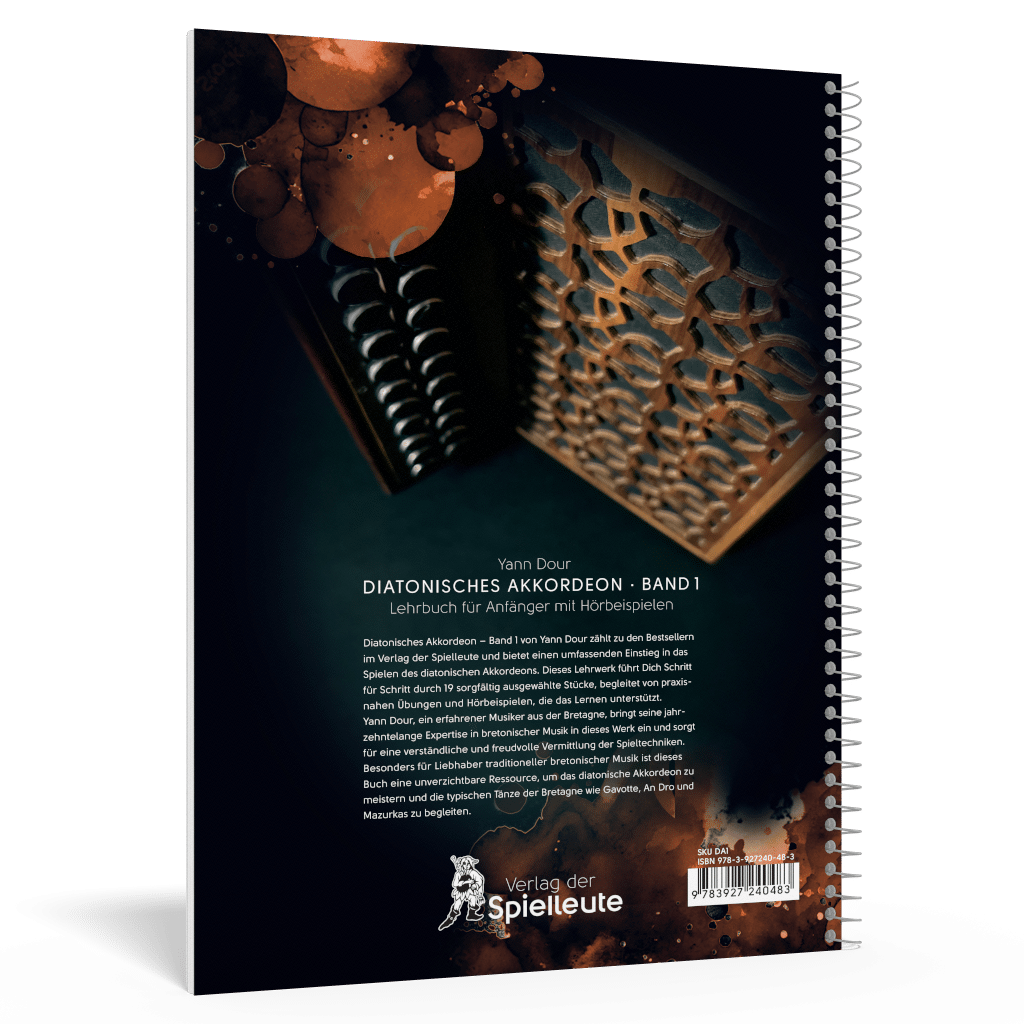
Text on the back of the book
Diatonic Accordion – Volume 1 by Yann Dour is one of the bestsellers published by Spielleute and offers a comprehensive introduction to playing the diatonic accordion. This textbook guides you step by step through 19 carefully selected pieces, accompanied by practical exercises and audio examples to support your learning.
Yann Dour, an experienced musician from Brittany, brings his decades of expertise in Breton music to this work and ensures that the playing techniques are conveyed in an understandable and enjoyable way.
Especially for lovers of traditional Breton music, this book is an indispensable resource for mastering the diatonic accordion and accompanying the typical dances of Brittany such as gavotte, an dro and mazurkas.